Section A

Social Media

Ready-to-post graphics and captions for Instagram, LinkedIn, Facebook, and X. Free to use for anyone helping amplify this research.
Instagram feed post
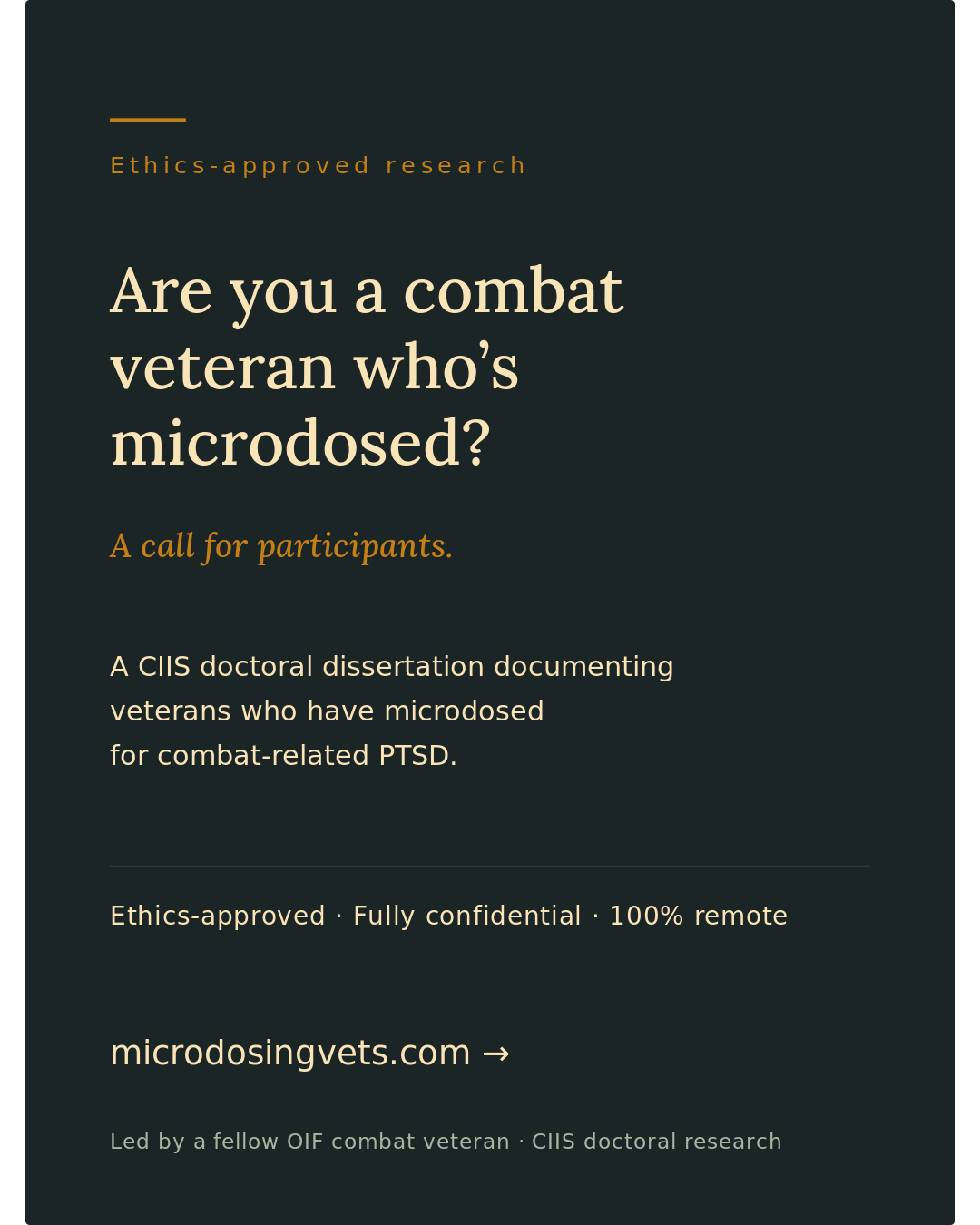
Instagram Feed Post
1080 × 1350 · Portrait 4:5 · SVG
Portrait-format post sized for Instagram's native feed ratio (1080×1350). PNG format — ready to post directly to Instagram.
Download PNG
Post Caption
Are you a veteran or know one? Sharing this with your network could help the entire veteran community. New therapeutic options for combat PTSD are being actively researched, and your share could reach the people this study is for. This is the first qualitative study documenting combat veterans' experiences with microdosing LSD for PTSD. Led by Patrick Nienaber — OIF combat veteran and CIIS doctoral candidate. Eligibility: — U.S. combat veteran (not currently serving) — PTSD diagnosis — 21–50 years old — Microdosing LSD experience Ethics-approved. Fully confidential. 100% remote. 5-minute screening at microdosingvets.com (link in bio). #combatveterans #PTSD #microdosing #psychedelicresearch #veteranhealth #OIF #OEF
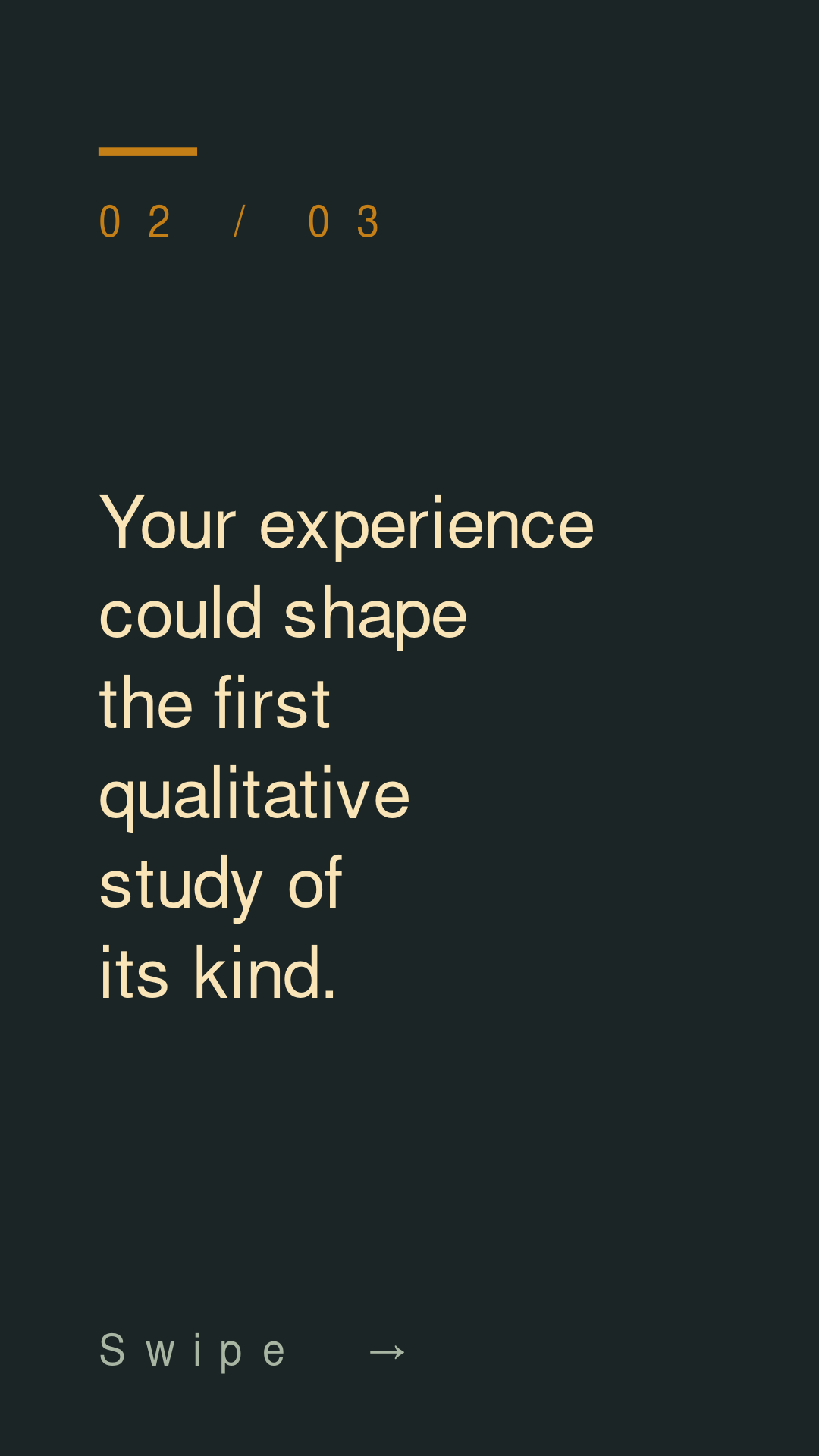
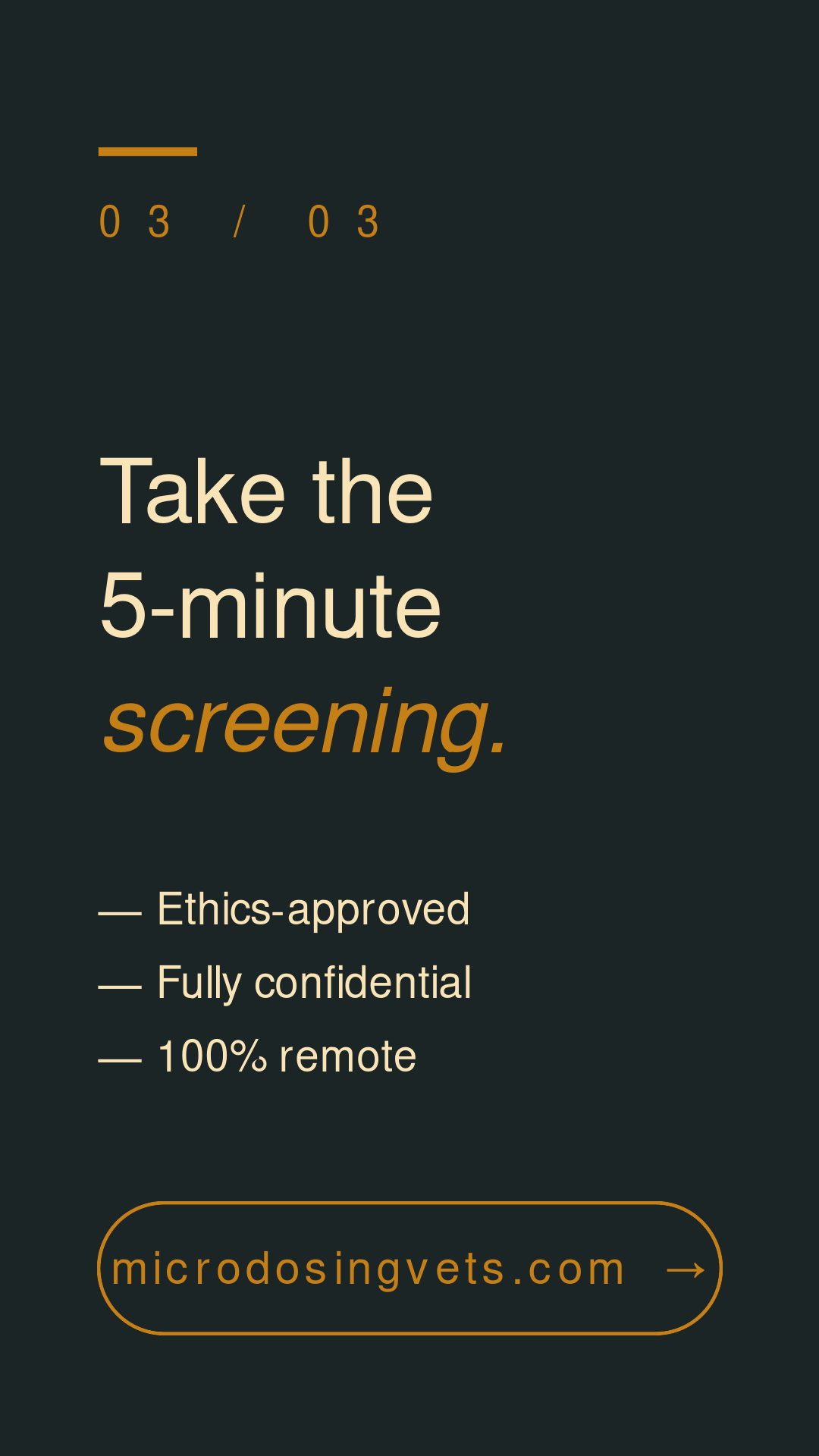
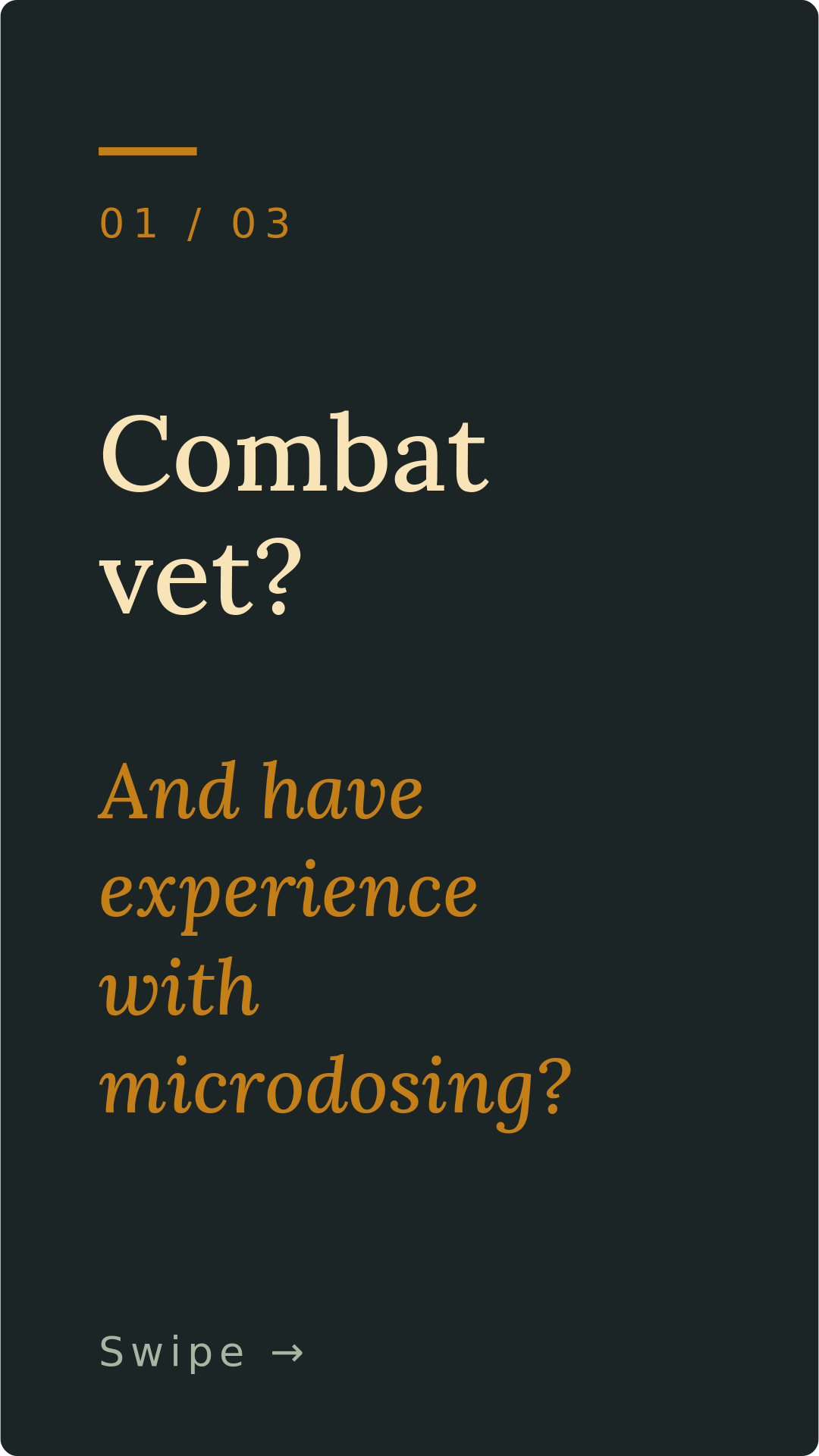
Story frame 1: Hook Story frame 2: Stakes Story frame 3: CTA
Instagram Stories · 3-Frame Sequence
1080 × 1920 per frame · Portrait 9:16 · SVG × 3
Three frames designed to run in sequence: Hook → Stakes → CTA. Post all three together. Add a link sticker on Frame 3 pointing to microdosingvets.com.
Frame 1 Frame 2 Frame 3
Posting Tips
• Post all three frames together in sequence — don't split across days • On Frame 3, add a link sticker pointing to microdosingvets.com so viewers can tap directly to the screening • Best time to post: 6–10 PM local (veteran audiences skew evenings) • Stories expire after 24 hours — safe to repost every 5–7 days without audience fatigue • For extra reach on Frame 2, add a poll sticker: "Are you a combat vet?" Yes / I know one / Neither
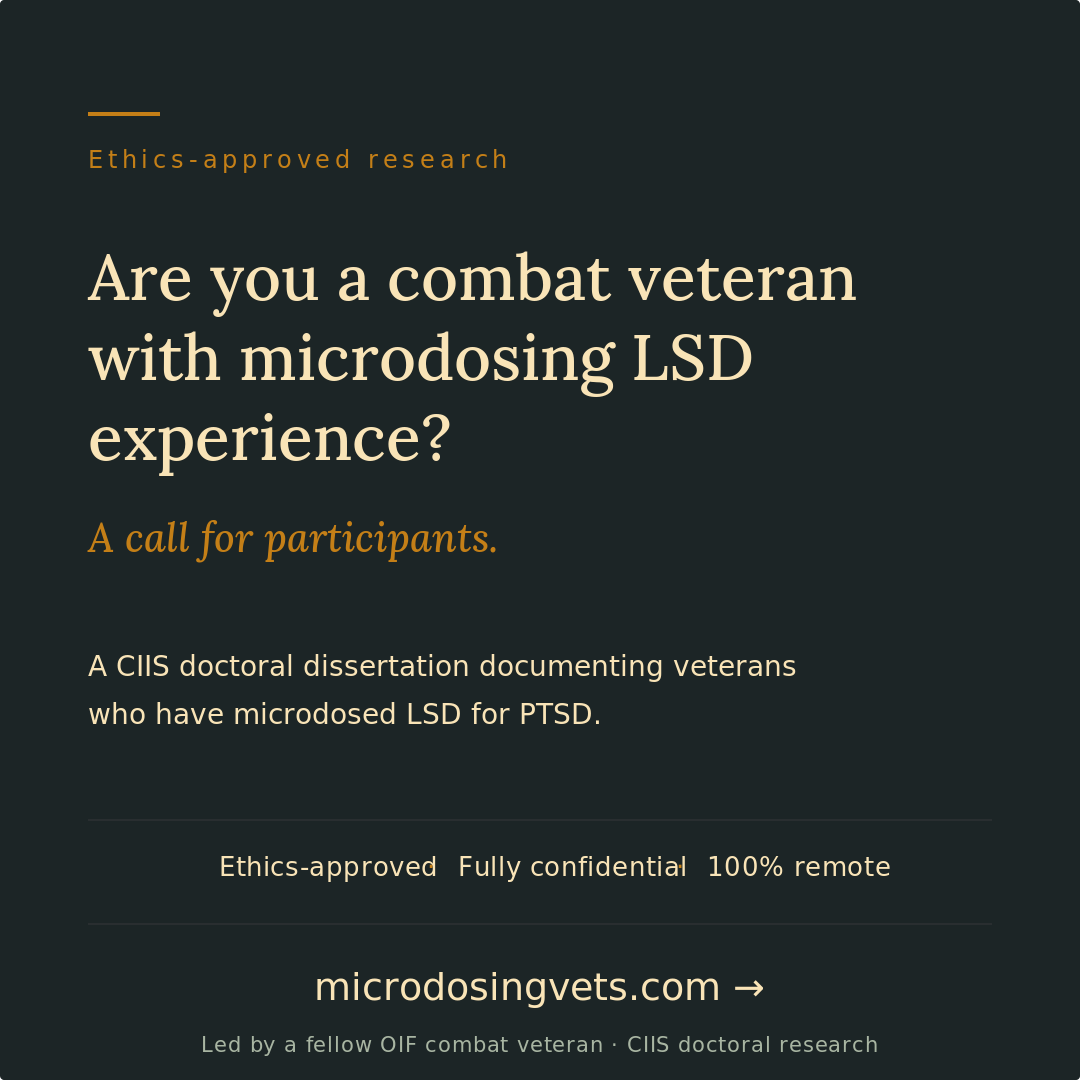
LinkedIn and Facebook square post
LinkedIn & Facebook
1080 × 1080 · Square · SVG · Works on both platforms
Square format sized for both LinkedIn and Facebook feeds. Same image, different captions — use the platform-specific copy below.
Download PNG
Post Captions
Sharing this could put a research opportunity in front of someone who needs it. Patrick Nienaber — OIF combat veteran and CIIS doctoral candidate — is conducting the first qualitative study to document what combat veterans have experienced with microdosing LSD as a self-directed PTSD intervention. A conversation that has, until now, happened almost entirely outside clinical settings. Eligibility: — U.S. combat veteran (not currently serving) — PTSD diagnosis — 21–50 years old — Microdosing LSD experience Ethics-approved. Fully confidential, de-identified data. Remote participation via Zoom. If you work with veteran populations, clinicians, or psychedelic research networks, your share could reach the people this study is for. 5-minute screening at microdosingvets.com #VeteranHealth #PsychedelicResearch #PTSDResearch #VeteransAffairs #DoctoralResearch
Sharing this could help reach a fellow veteran. Patrick Nienaber — OIF combat veteran and CIIS doctoral candidate — is conducting the first qualitative dissertation study documenting combat veterans' experiences with microdosing LSD as a self-directed PTSD intervention. If you're a U.S. combat vet with a PTSD diagnosis and experience microdosing LSD, your story matters to this research. Eligibility: — U.S. combat veteran (not currently serving) — PTSD diagnosis — 21–50 years old — Microdosing LSD experience Ethics-approved. Fully confidential. 100% remote. 5-minute screening at microdosingvets.com If you know someone who might want to participate, please share. New therapeutic options for combat PTSD are being actively researched, and your share could reach the people this study is for.
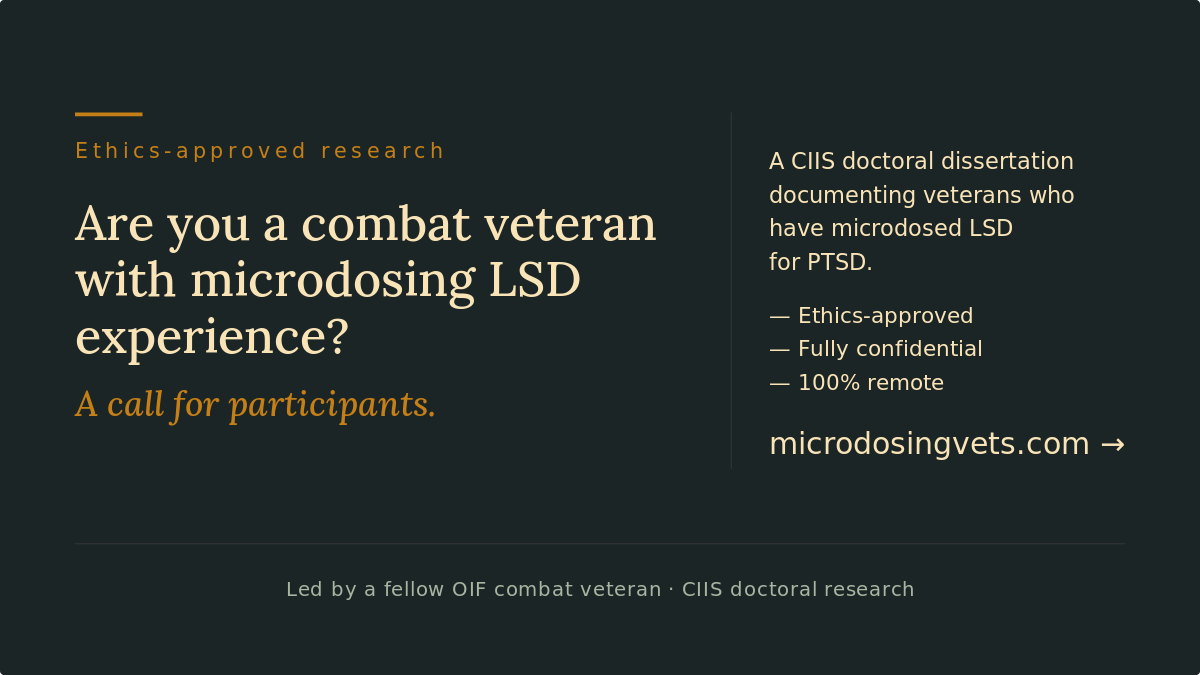
X / Twitter landscape post
X (Twitter)
1600 × 900 · Landscape 16:9 · SVG
Landscape-format image for X/Twitter. Attach to the first tweet in the thread below, or use with a standalone post.
Download PNG
Post Copy
Tweet 1 (attach image): Combat vet who's microdosed LSD for PTSD? Patrick Nienaber — OIF vet and CIIS doctoral candidate — is conducting the first qualitative dissertation study documenting veteran experiences with microdosing: what it did, what it didn't, what vets would tell each other. Ethics-approved. Fully confidential. 100% remote. A thread on how to participate: — Tweet 2: Clinical trials are accelerating after the April 2026 federal EO directing funding toward psilocybin and ibogaine for veteran PTSD. Meanwhile, what combat vets have learned microdosing LSD on their own has never reached the peer-reviewed literature. This study changes that. — Tweet 3: What you're agreeing to if you qualify: — One remote interview via Zoom (~80 min) — Fully de-identified, nothing traceable to you — Ethics-approved by CIIS — Zero cost, zero travel, zero paperwork beyond consent — Tweet 4: First step is a 5-minute screening survey to see if you're eligible. Anonymous. You'll know by the end whether you qualify. → microdosingvets.com — Tweet 5: If you know a combat vet who might want in — or if you work with veteran communities, clinicians, or psychedelic research networks — a repost gets this in front of the right people. Appreciate it.
Version A (research-forward): First qualitative study documenting combat veterans' experiences with microdosing LSD for PTSD. Ethics-approved. Fully confidential. 100% remote. Led by an OIF vet and CIIS doctoral candidate. 5-min screening: microdosingvets.com #PsychedelicResearch #VeteranHealth — Version B (peer voice): Are you a U.S. combat vet with a PTSD diagnosis and microdosing LSD experience? Your story could shape the first qualitative study of its kind. Ethics-approved. 100% remote. 5-min screening: microdosingvets.com #combatPTSD #veterans — Version C (share ask): Veteran or know one? This is the first qualitative study of combat veterans' microdosing LSD experience for PTSD. Your share could reach someone who needs it. Ethics-approved. microdosingvets.com #veterans

Section B

Press

Press release, researcher bios, and a visual mockup. If you've covered or shared any part of this research, thank you.
Press Release
For immediate release · AP style · Plain text + mockup
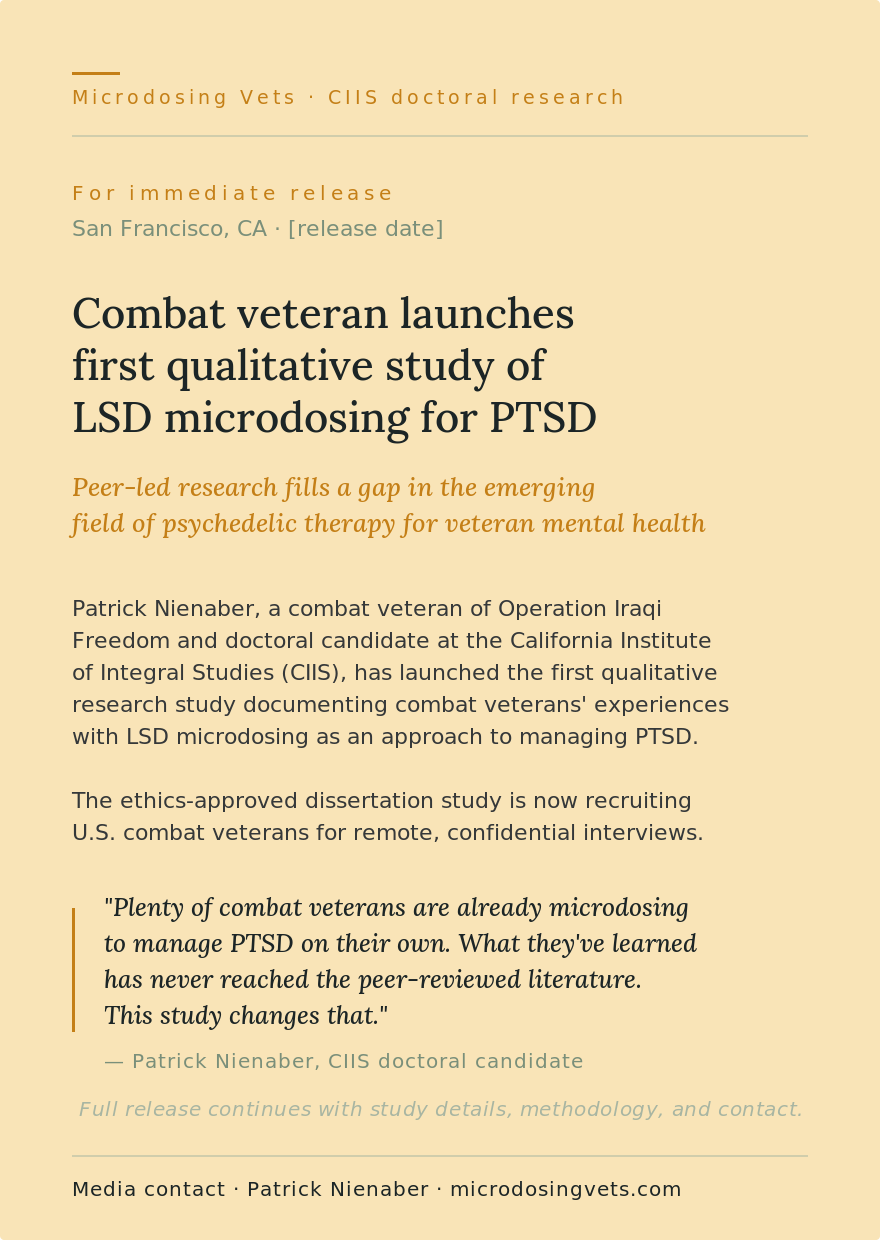
Full press release ready to file or adapt. The mockup below shows how it renders on letterhead.
Press release mockup
For Immediate Release

Combat veteran launches first qualitative study of LSD microdosing for PTSD

Peer-led research fills a gap in the emerging field of psychedelic therapy for veteran mental health

San Francisco, CA — [DATE] — Patrick Nienaber, a combat veteran of Operation Iraqi Freedom and doctoral candidate at the California Institute of Integral Studies (CIIS), has launched the first qualitative research study documenting combat veterans' experiences with LSD microdosing as an approach to managing PTSD.

The study addresses a notable gap in psychedelic research. While clinical trials of psychedelic-assisted therapy have drawn considerable attention and funding, no peer-reviewed research has documented what combat veterans themselves have experienced through self-directed microdosing.

"Plenty of combat veterans are already microdosing to manage PTSD on their own. What they've learned has never reached the peer-reviewed literature. This study changes that."

Participation involves a five-minute online screening survey, followed by a one-time remote interview of approximately 80 minutes via Zoom. All data is de-identified, participation is fully confidential, and the study is ethics-approved.

Interested combat veterans can learn more and complete the five-minute screening at microdosingvets.com.

Plain Text Version
FOR IMMEDIATE RELEASE Combat veteran launches first qualitative study of LSD microdosing for PTSD Peer-led research fills a gap in the emerging field of psychedelic therapy for veteran mental health San Francisco, CA — [DATE] — Patrick Nienaber, a combat veteran of Operation Iraqi Freedom and doctoral candidate at the California Institute of Integral Studies (CIIS), has launched the first qualitative research study documenting combat veterans' experiences with LSD microdosing as an approach to managing PTSD. The ethics-approved dissertation study is now recruiting U.S. combat veterans for remote, confidential interviews. The study addresses a notable gap in psychedelic research. While clinical trials of psychedelic-assisted therapy — most visibly MDMA for PTSD — have drawn considerable attention and funding, no peer-reviewed research has documented what combat veterans themselves have experienced through self-directed microdosing, a practice that has become increasingly common in veteran communities discussing mental health alternatives. "Plenty of combat veterans are already microdosing to manage PTSD on their own," Nienaber said. "What they've learned has never reached the peer-reviewed literature. This study changes that." Participation involves a five-minute online screening survey to determine eligibility, followed by a one-time remote interview of approximately 80 minutes via Zoom. All data is de-identified, participation is fully confidential, and the study is ethics-approved. Nienaber is an Iraq War veteran, a Tillman Scholar, and a doctoral candidate in CIIS's East-West Psychology program. "I know firsthand how inadequate conventional treatments can feel," Nienaber said. "This research is my mission to open new doors in veteran mental health — starting with listening to the veterans already walking through them." Interested combat veterans can learn more and complete the five-minute screening at microdosingvets.com. --- About the researcher: Patrick Nienaber is a doctoral candidate at the California Institute of Integral Studies, an Iraq War (OIF) combat veteran, and a Tillman Scholar. His dissertation research focuses on combat-related PTSD and emerging approaches to veteran mental health. Media contact: Patrick Nienaber · research@foundationlabs.us · microdosingvets.com ###
Researcher Bio
Three lengths — one-line, short (~50 words), long (~100 words)
Use the appropriate length depending on context: one-line for mentions and tweet replies, short for about pages and profiles, long for press releases and podcast intros.
Select Bio Length
OIF combat veteran and CIIS doctoral candidate conducting the first qualitative study of combat veterans' experiences with LSD microdosing for PTSD.
Patrick Nienaber is an OIF combat veteran, Tillman Scholar, and doctoral candidate at the California Institute of Integral Studies (CIIS). His dissertation research documents combat veterans' experiences with microdosing LSD as a self-directed approach to managing PTSD.
Patrick Nienaber is a doctoral candidate at the California Institute of Integral Studies (CIIS), a combat veteran of Operation Iraqi Freedom, and a Tillman Scholar. His dissertation is the first qualitative research study to document combat veterans' experiences with microdosing LSD as a self-directed approach to PTSD management. The study uses reflexive thematic analysis to surface lived experience that has not been captured by existing clinical literature. His work sits at the intersection of veteran mental health, emerging psychedelic research, and qualitative methodology grounded in the researcher-as-instrument tradition.

Section C

Print

Print-ready flyer for VSO offices, clinics, veteran events, and anywhere combat veterans gather.
Print flyer 8.5 x 11
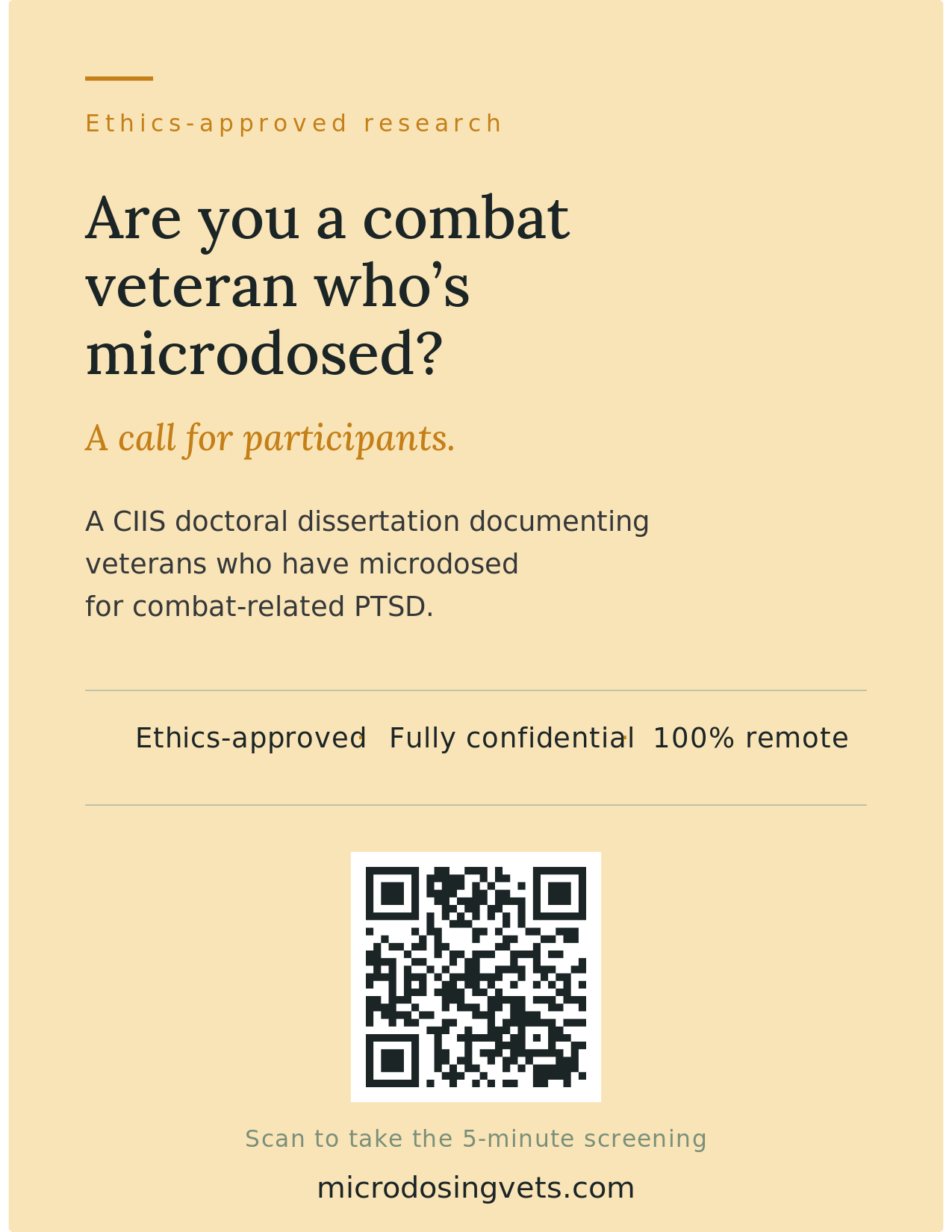
Print Flyer
8.5 × 11 in · Portrait · SVG · QR code embedded
The flyer includes a scannable QR code pointing directly to the Qualtrics screening survey — no additional setup needed. PNG format at print resolution (1275×1650) — ready to send to a printer or share digitally.
Download PNG
Printing Notes
• Recommended: 100–130 lb cover stock, matte finish • The warm cream background (#F9E4B7) prints as a subtle ivory — let your printer know it's not pure white • Bleed: 0.125" if using professional printing • Before bulk printing, do a single test print and scan the QR code on two different phones to confirm it lands on the screening page • Where to distribute: VSO offices, veteran-focused clinics, military family support centers, psychedelic research conferences, CIIS campus bulletin boards

Section D

Email & Partner Outreach

For use in emails, newsletters, or partner communications. If you've shared or adapted any of these, thank you.
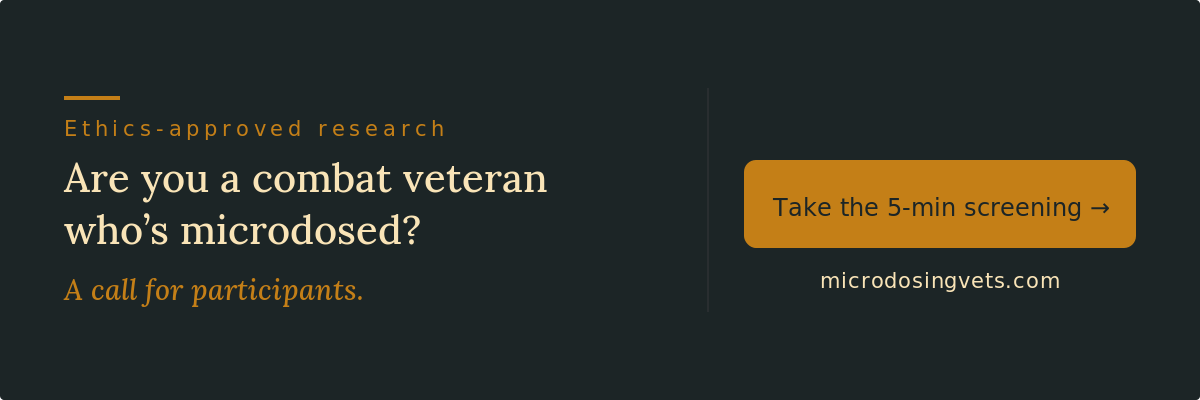
Email Banner
600 × 200 · SVG · For emails, newsletters, partner communications
Drop this banner into any email or newsletter to signal the research and drive traffic to the screening. Works in Mailchimp, Kit, Substack, and most email platforms that accept HTML or image uploads.
Download PNG
Usage Note
PNG format at 2× resolution (1200×400) — ready to embed in any email client or drag into your email builder. Wrap the image in a link pointing to: microdosingvets.com?utm_source=email-banner&utm_medium=email&utm_campaign=recruit

"If you've shared or adapted any of these, thank you."

Questions or custom requests — reach out directly.

Contact Patrick →